
The best time to visit Morocco is during spring (March to May) or fall (September to November).
You get warm, comfortable days across most of the country, cooler nights that make exploring cities like Marrakech and Fes actually pleasant, and prices that haven't yet spiked to peak-season levels.
Summer (June–August) gets brutally hot inland, and winter (December–February) brings cold nights and rain to the north both still workable depending on your route, but neither is the easy default.
Timing matters more than it used to, too. Morocco recorded 19.8 million tourist arrivals in 2025, up 14% from 2024, with tourism revenue reaching MAD 124 billion by the end of November 2025, up 19% year-on-year, according to Morocco's Ministry of Tourism. Announcing the figures, Tourism Minister Fatim-Zahra Ammor described the growth as reflecting "a more high-performing, more sustainable tourism that creates value at the territorial level" (translated from the original French). That growth means popular cities and months get busier every year, which makes knowing the best time to visit Morocco more worth planning around, not less.
Here's the month-by-month breakdown, plus how the answer changes depending on where in Morocco you're actually headed.
Quick answer: Morocco by season
| Season | Months | Good for | Watch out for |
|---|---|---|---|
| Spring | March–May | Best all-around balance of weather, price, and crowds | Late March/April can overlap with Easter travel spikes |
| Summer | June–August | Coastal towns (Essaouira, Agadir), Atlas Mountains | Marrakech, Fes, and the Sahara get extremely hot |
| Fall | September–November | Same strengths as spring, slightly warmer | Early September can still be quite hot inland |
| Winter | December–February | Lower prices outside the holidays, clear desert skies | Cold nights everywhere, rain in the north, cold desert nights |
What's Morocco's weather actually like by month?
Morocco is bigger and more climatically varied than most first-time visitors expect a "good time to visit" in Marrakech isn't automatically a good time to visit the Sahara or the northern coast. Here's the general pattern:
| Month | Marrakech / interior | Sahara Desert | Atlantic coast (Essaouira, Agadir) | Rain |
|---|---|---|---|---|
| January | Cool, 18°C/64°F days | Cold nights, mild days | Mild, breezy | Occasional in the north |
| February | Mild, warming up | Cold nights | Mild | Occasional in the north |
| March | Pleasant, 22°C/72°F | Warm days, cool nights | Mild, windy | Light |
| April | Warm, very comfortable | Warm days, cool nights | Pleasant | Light |
| May | Warm to hot, 28°C/82°F | Hot days begin | Pleasant | Minimal |
| June | Hot, 33°C/91°F+ | Very hot | Warm, popular for beaches | Minimal |
| July | Very hot, often 38°C/100°F+ | Extremely hot, avoid midday | Warm, breezy relief from heat | Minimal |
| August | Very hot | Extremely hot | Warm | Minimal |
| September | Hot but easing | Still very hot | Warm | Minimal |
| October | Warm, comfortable | Warm days, cool nights return | Pleasant | Light |
| November | Mild, cooling down | Cool nights | Mild | Occasional in the north |
| December | Cool, 18°C/64°F days | Cold nights, can approach freezing | Mild | Occasional in the north |
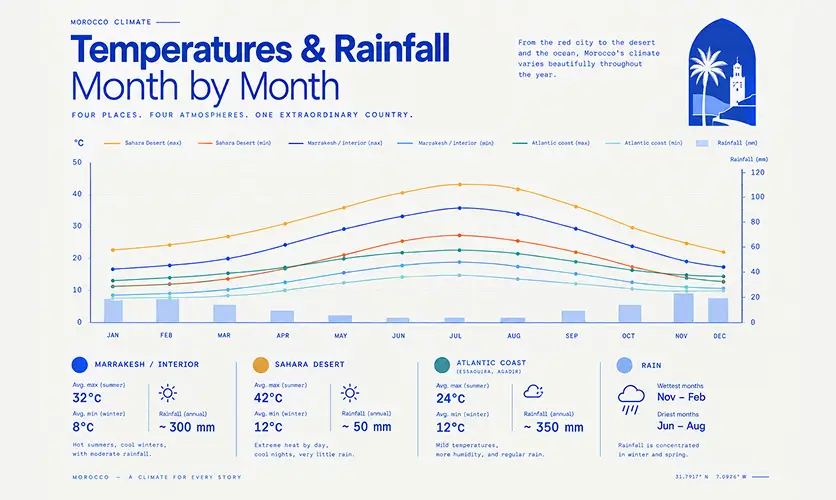
These are general patterns, not guarantees Morocco's weather, like anywhere, varies year to year. For a live forecast close to your travel dates, check Morocco's official National Meteorology Directorate (DGM) rather than relying on averages alone.
What month is best to go to Morocco?
If you can only pick one single month, April or October are the strongest choices.
Both sit in the heart of shoulder season comfortable temperatures across nearly the whole country, without the price premium of the Christmas/New Year weeks or the extreme heat of peak summer. April has a slight edge for greener landscapes after spring rain; October has a slight edge on price, as accommodation costs ease down from the summer peak.
What is the cheapest time to visit Morocco?
Winter December through February, excluding the Christmas and New Year weeks is generally the cheapest time to visit Morocco.
Accommodation prices ease down from peak-season rates, and desert tours often cost less than in shoulder season or summer. Flights follow the same pattern: fares typically peak around the holidays and in the middle of summer, and ease off in winter and shoulder season, so it's worth comparing a few months before locking in dates rather than assuming your preferred season is also the cheapest to fly.
The trade-off with winter is colder nights everywhere and more rain in the north. The one exception is the holiday weeks themselves, when prices spike well above the rest of the winter baseline see below.
When should budget travelers specifically visit Morocco?
If cost matters as much as comfort which it does for most people reading a budget travel guide shoulder season (April–May or October–November) is the sweet spot:
- Avoids the summer heat that makes long bus rides and city walking genuinely miserable
- Avoids the price surge around Christmas/New Year and Easter
- Hostel/riad prices in popular cities sit at their normal rate rather than peak-season markup
Winter (excluding the December holiday weeks) is actually the cheapest time to visit for accommodation, and it's a smart call if your route leans coastal or you don't mind cool evenings just budget for warmer layers, especially if you're heading into the Sahara, where desert nights get cold even when the days are pleasant.
I visited Marrakech and Agadir in July 2026, and the reality on the ground was more manageable than the averages might suggest midday temperatures sat around 28–35°C rather than the more extreme highs Marrakech can hit at the peak of summer.
The trick was simple: I avoided being out between roughly midday and 4–6pm, using that window to duck into an air-conditioned café rather than push through it.
A hotel ran about $20/night, and my daily budget landed somewhere between $50 and $100 depending on whether I was buying extras that day.
One thing that actually surprised me: the heat didn't mean fewer tourists. I remember walking through the medina in the early evening and still having to weave through groups of tourists around the souks and Jemaa el-Fnaa, even after the worst of the afternoon heat had passed. That was the moment I realized July wasn't really an off-season in Marrakech just a hotter one.
If I'm being straight about it: I'd still point a budget traveler toward before July or after September if the goal is spending less. July itself wasn't the ordeal the raw temperature numbers make it sound like but it wasn't the cheapest or quietest time either.
Is Ramadan a good time to visit Morocco?
It can be, but it changes how the country runs day-to-day, so it's worth planning around rather than being surprised by.
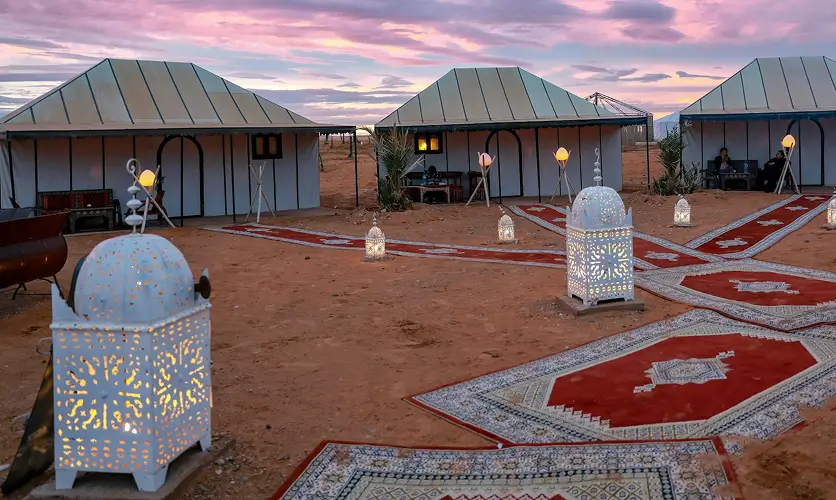
During Ramadan, many restaurants and cafés especially outside major tourist areas close or reduce hours during daylight, since the majority of the population is fasting from dawn to sunset. Tourist-heavy areas of Marrakech, Fes, and other major cities generally stay more accessible, but the overall rhythm of the country shifts: things get quiet during the day and come alive after sunset (iftar), often with a lively atmosphere in the evenings.
Ramadan in 2027 is expected to run from approximately February 7 to March 8, though the exact dates depend on the moon sighting and can shift by a day or two check timeanddate.com's Ramadan calendar closer to your travel dates for the confirmed start.
If you do visit during Ramadan:
- Carry snacks and water for daytime, since options are limited until sunset
- Expect slower service during the day, even in tourist areas
- Be mindful about eating or drinking in public out of respect for those fasting
When should you avoid visiting Morocco?
Two windows are worth thinking twice about, depending on your plans:
- Peak summer (July–August) if your route is inland or desert-heavy. Marrakech and the Sahara can be genuinely dangerous-hot, not just uncomfortable regularly exceeding 38–40°C/100–104°F in Marrakech and higher in the desert, though actual conditions vary year to year (see the first-hand July account above, where midday temperatures ran cooler than this). If summer is your only option, lean coastal (Essaouira, Agadir) instead, and plan around the midday heat rather than through it.
- Christmas/New Year's week, if budget is your main constraint. This is the one stretch of winter where prices spike well above the otherwise-cheap winter baseline, across accommodation and desert tours alike.
What's the best time to visit each region of Morocco?
Because "Morocco" covers desert, mountains, and two coastlines, the honest answer depends on where you're actually going:
- Marrakech and the interior cities (Fes, Meknes): Spring and fall, clearly. Summer heat here is a real obstacle, not just a minor discomfort.
- The High Atlas Mountains (Toubkal and beyond): Best for trekking in spring through fall. Winter brings snow to higher elevations, and some routes close or require crampons and a qualified guide check current conditions before planning a winter trek.
- The Sahara Desert (Merzouga, Zagora): Spring, fall, or even winter days desert daytime temperatures are manageable most of the year outside summer, but pack layers for cold nights regardless of season.
- The Atlantic coast (Essaouira, Agadir, Taghazout): The most forgiving region pleasant nearly year-round, and actually a smart summer alternative when the interior is too hot.
- The north (Chefchaouen, Tangier): Similar shoulder-season logic to Marrakech, but winters here bring more rain than the south pack for it if visiting December–February.
After the intensity of Marrakech, arriving in Essaouira felt like a different country. The Atlantic wind was strong enough that I ended up spending far more time than planned just walking the waterfront, watching the fishing boats come in, and wandering the medina without any real rush. The stand-out moment was sitting near the port with a simple seafood meal, watching the boats come and go. I hadn't planned much for that afternoon, and that turned out to be exactly the point of Essaouira.
Best Time to Visit Morocco FAQs
What is the best time to visit Morocco overall?
Spring (March–May) and fall (September–November) are the best time to visit Morocco for most travelers comfortable temperatures nationwide, manageable prices, and no extreme heat or holiday-season price spikes. The right answer can shift depending on your budget, route, or interest in Ramadan, which is why the sections above break it down further.
What is the hottest month in Morocco?
July and August are the hottest months across most of the country, with inland cities like Marrakech and the Sahara frequently exceeding 38°C/100°F.
What is the coldest month in Morocco?
January is typically the coldest, especially at night desert and mountain areas can approach freezing, even though daytime temperatures often remain mild.
Can you visit the Sahara Desert in summer?
You can, but daytime temperatures are extreme and generally not recommended for full-day activities. If you're set on a summer desert trip, plan activities for early morning or evening and expect very hot midday hours.
Is Morocco rainy in winter?
The north (Chefchaouen, Tangier, Fes) sees noticeably more winter rain than the south. Marrakech and the desert stay mostly dry even in winter, with occasional light rain.
Conclusion
Overall, the best time to visit Morocco comes down to shoulder season spring or fall unless your budget, your route, or an interest in experiencing Ramadan points you toward a different month instead.
Planning your trip? See our Morocco budget guides for what to expect cost-wise by season, or check our Sahara desert tour guide for the best months to book a desert trip.


